In short
- fyrr has two halves, a writer and a reader, that share nothing but an S3 prefix or a local directory.
- This page defines the terms the other pages use and explains publication, authorization and retrieval.
- Read it when you want to know what happens between a sync and a search result.
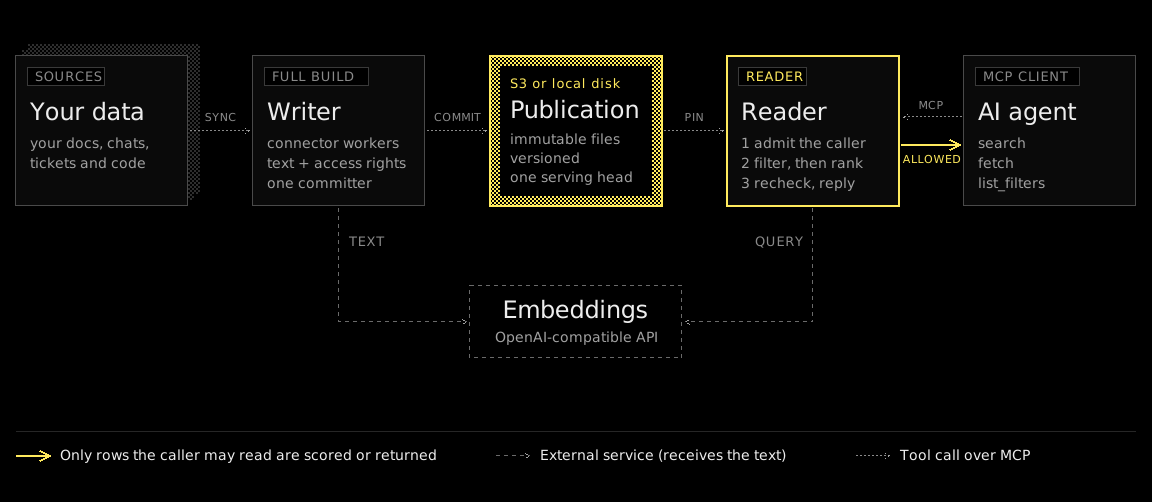
fyrr has two halves that share nothing but an S3 prefix (storage.uri), or
on a single host a local directory:
- The writer (full build) runs connector providers, prepares their output and publishes it.
- The reader (reader-only build, or the full build) serves the published
data over MCP. The reader-only build links no Python and no writer code;
scripts/check-reader-onlyproves it in CI.
Terms
| Term | Meaning |
|---|---|
| namespace | One deployment's data under storage.uri, named by namespace.name. Every writer and reader of a deployment uses the same namespace. |
| source | One [[sources]] entry: a connector type, what it syncs (scope) and how its readers are decided (permissions). |
| reader token | A user or group grant on a row: usr:<id> or grp:<id>. Stored only as an HMAC digest. Not to be confused with OIDC access tokens, which authenticate HTTP callers. |
| publication | One immutable, published version of the namespace: the Lance content plus the policy and identity it is served with. |
| serving head | The single control object that names the current publication, policy and identity. Each commit replaces it in one conditional write. |
| pin | The publication one request reads from start to finish. |
| envelope | A durable batch a sync has validated and embedded, waiting for the committer to publish it. |
| mirror | The reader's local cache of immutable published files (reader.mirror_path). |
| admission | The reader's check, at the start of every request, that the caller is known and the pinned publication may be served. |
| Lance | The table storage and retrieval engine used for published text, vectors and indexes. |
root_id / record_id | A source's stable document ID / the ID of one text record within that document. |
| principal / canonical user | The deployment's user identity to which source accounts and authenticated subjects are linked. |
| committer | The writer holding the namespace lease while publishing prepared work. |
| incarnation | A new identity assigned when a namespace is created, distinguishing it from earlier namespaces at the same URI. |
| freshness deadline | The maximum age of a successful permission, membership or directory read before its grants stop being served (identity.validity_deadline). |
| quarantine | Withholding an invalid document revision while retaining its last good published revision, if any. |
| provider | A connector provider reads source content and access rights; a directory provider supplies canonical users and groups; an embeddings or reranker provider processes text for retrieval. |
Publication
- Sync.
fyrr writer syncruns each source in its own worker process under an expiring S3 lease per source and sync kind. Every batch is validated against the connector contract (Arrow schema, row rules, cursor chain, size bounds), embedded, and written as a durable envelope. The source's cursor advances only after its envelope is durable. An invalid or oversized document is quarantined and its last good revision stays visible. - Commit.
fyrr writer committakes the namespace lease, which lives in the serving head; a second committer exits instead of waiting. The committer publishes permission and membership changes before content, appends rows and index deltas to the Lance dataset, writes an immutable content manifest and replaces the serving head with one conditional write (compare-and-swap on the object version). A failed conditional write leaves the writer refusing to continue (head_cas_failed). - Serve. Each reader request pins one publication. Readers notice new
publications in the background (
reader.version_check_interval, 30 s, orSIGHUP) and switch between requests; in-flight requests keep their pin. A reader whose pin predates a published revocation stops serving until it has prepared the newer publication. Each namespace creation writes a new random incarnation into the serving head and every publication; a reader whose pin belongs to a namespace that was deleted and created again at the same storage URI stops serving at once and prepares the new namespace's publication.
Published versions are retained for writer.purge_window and can be
restored; see operations.
Every artifact carries a major.minor contract version. An unknown major
is refused with publication_invalid at startup or
authorization_unavailable on a live request. A publication whose indexes
or retrieval policy do not match is refused with incompatible_index. The exact formats are generated into schemas/
and fixtures/.
Local storage
A file:// root stores the same namespace objects and Lance dataset as S3.
Each write stages its object in .fyrr-storage.stage.d/, flushes it, gives
it its name with an atomic rename and flushes the directory before it
reports success. An object's version is a random 128-bit tag in an extended
attribute; an object without one is refused.
Writes to different objects never wait for each other. Creating an object
takes no lock. Replacing or removing one (the serving head, a lease, a
cursor) locks that object only for the comparison and the rename, never
while flushing. A process stopped inside that step blocks later changes to
that one object: they wait up to five seconds and then fail with
storage_unavailable, head_cas_failed or sync_lease_lost, depending on
the operation.
A reader can see an object before its writer has flushed the directory, so a
writer that publishes a reference to something it only observed flushes it
first. Lance uses an atomic create-exclusive link. Staging files of a killed
writer are removed by later writes and by every delete; a stopped writer
keeps its file. .fyrr-storage.lock remains in the root and stops earlier
releases, which serialized all writes through it, from writing there.
Maintenance and confirmed
source purge reap abandoned multipart uploads (name#digits), protecting
files younger than ten minutes and namespaces with live source leases;
purge plans count them as namespace_staging_files. Reader mirrors copy immutable files and preserve
in-flight pins across purge, bounded by reader.mirror_max_bytes.
Authorization
The writer replaces every reader token with an HMAC-SHA256 digest keyed by
identity.hashing_key before it is stored. A published identity artifact
maps each subject (the stdio user, or an OIDC subject over HTTP) to the
hashed reader tokens it holds.
Every search, fetch and list_filters call passes three gates:
- Admission. The reader reads the live serving head, policy and
identity. A malformed head, a head from another namespace, or missing or
malformed policy or identity refuses with
authorization_unavailable. An unreadable head or expired pin givesstorage_unavailableon stdio. Admission also refuses a subject that is not in the identity artifact or holds more thanidentity.max_tokens_per_userreader tokens, and an expired directory read (identity.validity_deadline) when a directory provider is configured. Apermissions = "sync"source whose last successful permission or membership read is older thanidentity.validity_deadlineis excluded, and named inmetadata.hidden_sourcesif the caller could otherwise read it. A retired source is excluded silently. - Permission predicate. Lexical and dense candidates are generated under
a filter on the row's hashed readers, so a row the caller may not read is
never scored, counted or returned. For
permissions = "fixed"sources the filter checks the readers in the current policy, not the stored rows. - Final check. Before a result or error is returned, the reader reads the serving head again. If the policy, identity or hidden sources changed during the request, the request is refused rather than answered under the old grant.
Unknown and denied documents look the same to fetch: an empty result.
Source revocations require a successful sync that reads the changed rights
and a commit that publishes them; in-run changes can be missed.
Retrieval
A search runs two candidate lanes over the permission-filtered rows:
- lexical: native full-text search (BM25) on the Lance
fts_idxindex; - dense: IVF vector search on the query embedding. The query is embedded
only after admission and only when
embedding.reader_live = true; otherwise, or when the embedding call fails, the lexical lane answers alone and the response reportsdegraded: ["dense"].
The two score lists are normalized, fused (weight 0.5 lexical, 0.5 dense
by default) and grouped to one hit per document. A soft per-source cap
spreads the top of the list across sources; remaining slots may still come
from the same source. An optional reranker ([namespace.rerank]) reorders
the authorized documents. Excerpts are passages of up to 1200 codepoints
around the query terms; fetch returns whole documents or a window of one
record.
Fusion weights, depths, analyzer settings and composition enter one retrieval-policy digest that is published with each version, so readers and writers cannot silently disagree about ranking. The tuning keys are in tuning; the tool arguments and outputs are in MCP tools.